
NewGenEngine
NewGenEngine / canonical infrastructure
Current phaseInfrastructure built → Validation → Publication

Verified compute. Reconciled AI. Canonical state.

NewGenEngine connects NewGen L1, E2 Compute Hub, and NewGen AI within explicit authority boundaries.
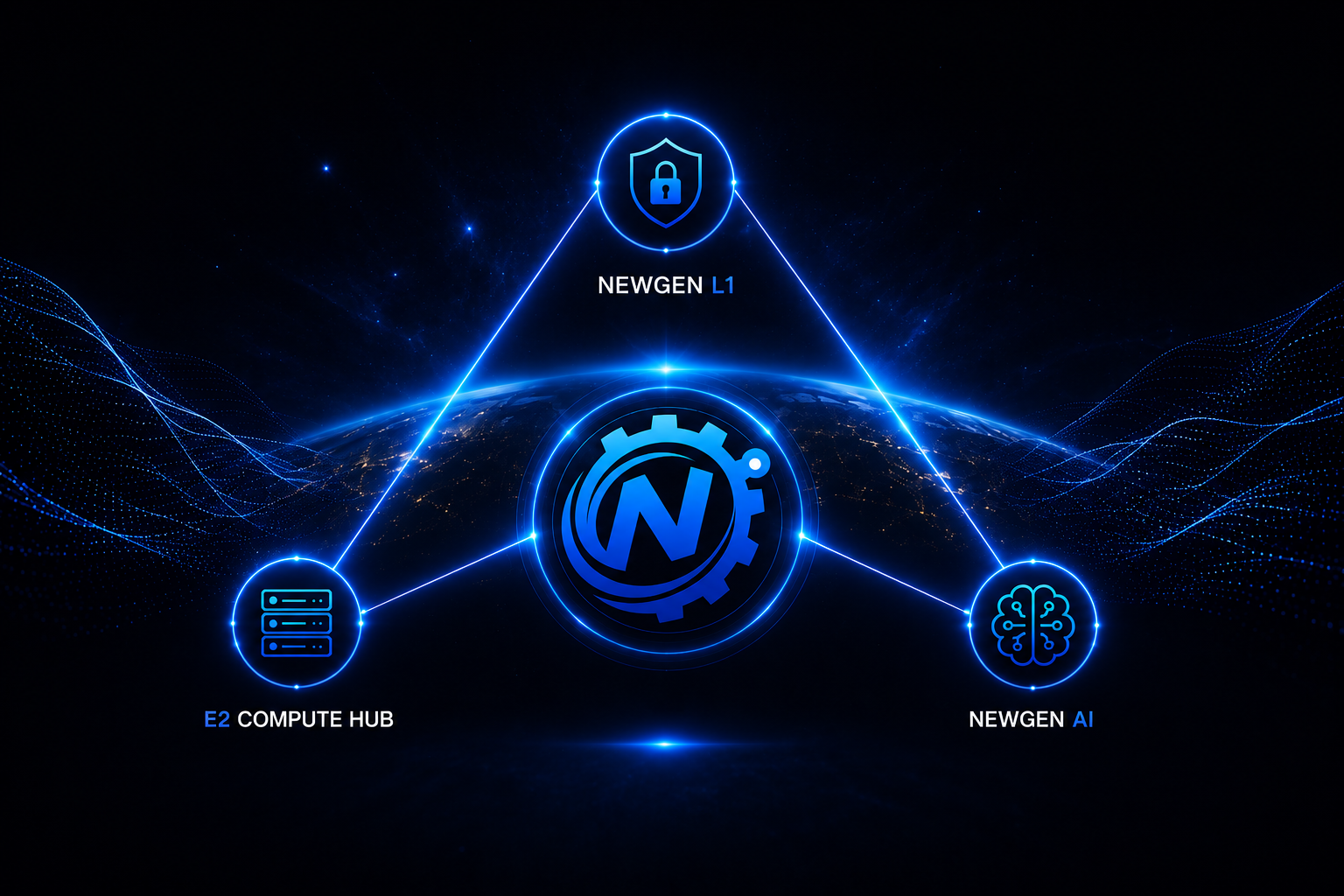
Authority Boundary
Execution produces work.
AI produces analysis.
Only NewGen L1 makes state canonical.
NewGenEngine
NewGen L1 • E2 Compute Hub • NewGen AI
L1E2AI
Canonical StateReceipt → Attestation → Finality
Canonical blockchain layer
NewGen L1
canonical source of truth
Execution layer
E2 Compute Hub
commissioned workloads
AI layer
NewGen AI
state reconciliation
Public positioning
Evidence-first
runtime-first
Architecture

A system designed as three connected ecosystems.

Canonical truth, commissioned execution, and AI functions are intentionally separated. No layer gets implicit authority outside its role.

Layer 01

NewGen L1

Canonical blockchain layer
The canonical foundation of the NewGen ecosystem, responsible for trust, finality, settlement, governance, adaptive economics, and public authority over what becomes canonical.
Layer 02

E2 Compute Hub

Commissioned execution layer
A commissioned execution and data-center layer designed for bounded workloads, controlled participation, and reputation-aware node selection rather than open implicit trust.
Layer 03

NewGen AI

Proprietary AI system
A full proprietary AI system built in-house for interaction, reasoning, tool use, and bounded coordination across the wider NewGen ecosystem.
1
NewGen L1

Canonical State

The blockchain defines verified state, settlement, governance, and finality.

2
E2 Compute Hub

Bounded Execution

Compute work is executed within explicit constraints, receipt records, and reputation-based participation.

3
NewGen AI

Reconciled Intelligence

AI reads, reasons, and reconciles against verified state instead of becoming authority itself.

Evidence-first

Observable results, not marketing promises.

The public surface points to sanitized runtime traces: chain progress, adaptive fee behavior, finalized-state tracking, and chain-bound execution finality.

L1 Runtime Progress
OBSERVED

Blocks applied, finality-related state observed, snapshot cadence active.

sanitized traceruntime
$ [L1] new_block_intake state=applied sync_state=idle$ [L1] finality_state=observed reason=tip_extend$ [L1] snapshot_export_ok bundle=bootstrap-latest
Adaptive Fee Behavior
VALIDATED

Idle decay, bounded recovery, stress response, and commit-follow behavior.

sanitized traceruntime
$ [L1] fee_controller action=lower pressure=idle$ [L1] prospective_fee=80 canonical_fee=81 delta=-1$ [L1] empty_block_fee_charge=false selected_txs=0
E2 Finalized Tracking
SYNCED

Coordinator catches up finality-confirmed blocks and follows canonical progress.

sanitized traceruntime
$ [E2] chain_watcher=catch_up finalized_tip=observed$ [E2] processed_finalized_blocks cursor=advanced$ [E2] follow_mode=live canonical_progress=synced
E2 Job Finality
FINALITY-BOUND

Off-chain execution becomes relevant only through blockchain-bound receipt and finality.

sanitized traceruntime
$ [E2] artifact_produced status=non_canonical$ [NewGen AI] intent_reconciled canonical_evidence=checked$ [L1] receipt_finalized canonical_relevance=true
Observable results, not marketing promises.

Public notes should stay short, sanitized, and tied to behavior that can be inspected.

View Project Status
Network economy

Reputation links verified participation to commissioned execution.

NewGenEngine is designed so reliability, stake, slashing, and reputation remain tied to canonical protocol state rather than local claims.

The blockchain layer provides canonical state and the economic foundation of the system. Validator behavior, runtime evidence, reputation, and protocol enforcement are designed to converge before any participant becomes trusted for higher-value work.

Work eligibility should depend on verified participation and canonical state, not self-reported performance. Compute demand, node reliability, receipt records, and settlement are coordinated through NewGen L1.

Stake, slashing, reputation, and finality should reinforce useful work instead of becoming disconnected metrics.
System layer maturity

The system layers mature in controlled stages.

The public surface separates what is ready to show from what remains controlled. Chain and compute are closer to public exposure; AI remains bounded while model-building progresses.

NewGen L1
Core substantially completed
The canonical blockchain layer is in final low-risk refinement and validation, with public claims tied to observable runtime behavior.
E2 Compute Hub
Core substantially completed
The compute and data-center layer is also in final low-risk refinement and validation, with emphasis on controlled execution and reputation-based participation.
NewGen AI
Stack active, controlled disclosure
The proprietary AI stack already includes core internal components such as tokenizer, run engine, and controlled data/token pipeline. Public disclosure remains staged while model-building progresses.
AI

The AI system is real, but it is not treated as an authority shortcut.

NewGen AI is being built as a full system, not as a thin assistant. At the same time, it remains bounded by explicit architecture and reconciliation rules.

NewGen AI is being developed as a proprietary cognitive system for conversational interaction, reasoning, verification, tool use, and bounded coordination across the wider NewGen ecosystem. Its public role is real, but it is not presented as a replacement for canonical chain authority or as a shortcut around the system’s trust model.

Further model capabilities will be disclosed only when the evidence, benchmarks, and public release surface are ready for technical scrutiny.

Public documentation

Current public material is being released in a controlled way.

The documentation already published is intentionally filtered. It is meant to explain what exists today without exposing sensitive internal detail.

Repository README
Public entry point
A public overview of the three ecosystems, the role of the repository, and the current publication posture.
Current Status
High-level project status
A concise snapshot of current maturity across chain, compute, and AI.
Project Status Update
First public report
A more explicit public-facing update on the current phase, scope, and communication posture of the project.